
HOME > OUR JOURNEYS > BROWSE BY CITY > AHMEDABAD
AHMEDABAD
India’s First UNESCO World Heritage City
Architecture, craft and heritage tours in Ahmedabad with WalkAroundIndia.
Ahmedabad is often overlooked in favor of India’s more famous heritage cities, but one of its greatest distinctions is a title no other Indian city holds: in 2017, it became the first city in India to be designated a UNESCO World Heritage City — not for a single monument, but for an entire living urban fabric spanning 600 continuous years, from Sultanate-era mosques to some of the twentieth century’s most significant modernist architecture.
One of the most fascinating facts about Ahmedabad’s architecture is how much of its identity rests on a single carved window. The Sidi Saiyyed Mosque, built in 1573, is famous the world over for its Tree of Life jali — a stone lattice screen carved with such delicacy that it has become an unofficial symbol of the city itself, reproduced on everything from postcards to the logo of the Indian Institute of Management just a few kilometers away.
Ahmedabad’s old city preserves an equally distinctive urban innovation: the pol. These dense, self-contained residential clusters, each with its own gated entrance, shared temple, and communal well, represent one of India’s most sophisticated traditional planning systems — designed for community, security, and climate all at once, and still inhabited today largely as they were centuries ago.
Just outside the old city, the Adalaj Stepwell offers a different kind of architectural marvel. Built in 1499, this five-story stepped water structure blends Hindu and Islamic ornamentation into a single design — a functional response to Gujarat’s dry climate that became, almost incidentally, one of the region’s most beautiful buildings.
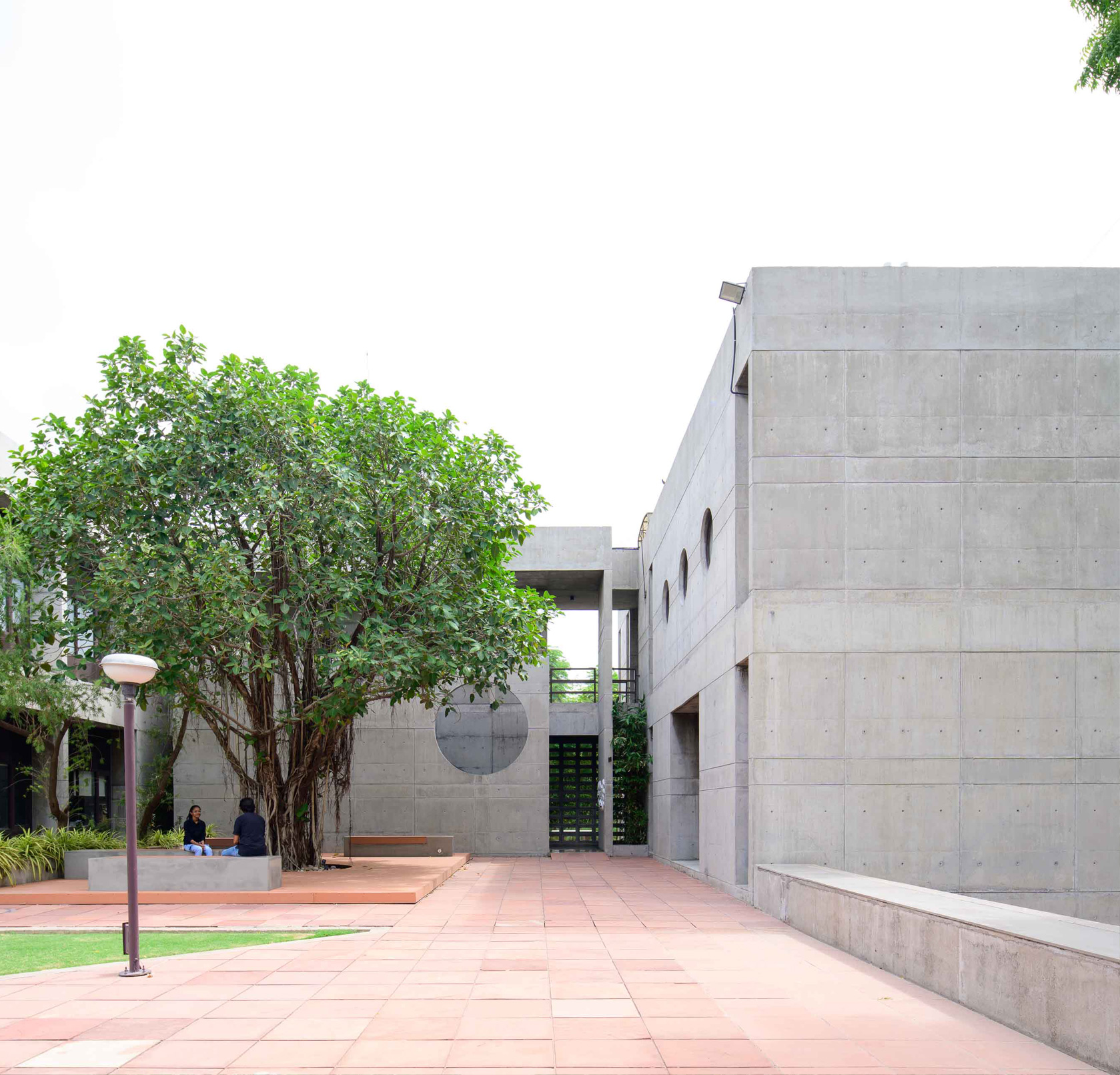
Ahmedabad’s architectural story does not end with its historic core. In the twentieth century, the city became an unlikely proving ground for modernist architecture at its most ambitious. Le Corbusier built the Mill Owners’ Association Building, Villa Shodhan, and Villa Sarabhai here — a concentration of his work outside Chandigarh and Europe unmatched anywhere else in India. Louis Kahn followed with the Indian Institute of Management, a monumental composition in exposed brick that remains one of the finest works of modern architecture on the subcontinent. And B.V. Doshi — who trained under Le Corbusier before developing an entirely personal architectural language — built his own studio, Sangath, along with CEPT University, cementing Ahmedabad’s improbable status as a living museum of both ancient and modern architectural thought.
Unlike Jaipur’s planned pink-washed grid or Lucknow’s Persian-influenced stucco palaces, Ahmedabad’s architectural character is defined by continuity across eras that, elsewhere, rarely speak to each other. A fifteenth-century stone jali and a twentieth-century concrete brise-soleil are, in their own way, solving the very same problem — filtering harsh Gujarati sunlight into something livable — five hundred years apart.
Ahmedabad’s craft and design heritage runs every bit as deep as its architecture, and often the two are inseparable. Gujarat is home to some of India’s most celebrated textile traditions — Patola, the double-ikat silk weave from nearby Patan, so labor-intensive that a single sari can take months to complete; Bandhani tie-dye, recognizable by its tiny hand-tied dot patterns; and Ajrakh block printing from Kutch, with its deep indigo and madder-red geometric motifs. Many of these traditions are preserved and displayed at the Calico Museum of Textiles, housed in a traditional haveli, but they’re also very much alive in the city’s markets and artisan workshops today.
Ahmedabad is also home to the National Institute of Design (NID), founded in 1961 and still India’s most prestigious design institution — a direct, living link between the city’s centuries-old craft traditions and its equally serious modernist architectural legacy. Few cities anywhere ask you to hold “ancient craft” and “cutting-edge design” in the same thought quite as naturally as Ahmedabad does. And running through all of it is a thread of modern political history: Sabarmati Ashram, Gandhi’s home from 1917 to 1930 and the starting point of the 1930 Salt March, sits quietly within the same city that gave the world Le Corbusier’s concrete experiments and a five-century-old stepwell.
Ready to walk through five centuries of Indian architecture, art & craft in a single city? Book your Ahmedabad journey, or write to us at experience@walkaroundindia.com to start planning.