

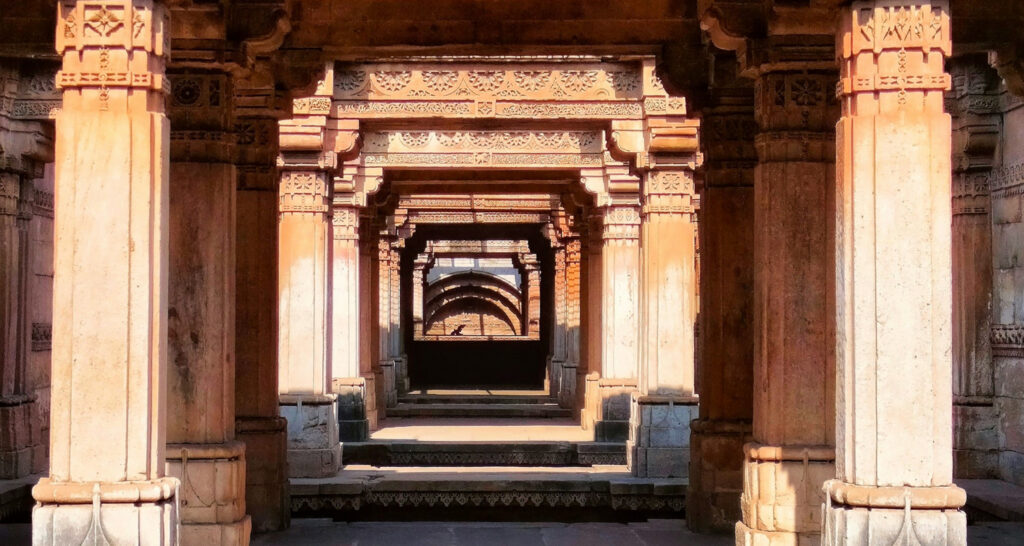
Ahmedabad is not a heritage city because it has old buildings.
It feels like a heritage city because people still live, work, pray, trade, cook, celebrate and create within its historic fabric.
When I walk through Ahmedabad’s old city, I don’t want my guests to simply look at beautiful wooden houses and photograph carved façades. I want them to notice what happens between the buildings.
The narrow lanes of the pols.
The old wooden havelis.
Small temples tucked into neighbourhoods.
Bird-feeding structures.
Markets opening in the morning.
Craftspeople at work.
Families continuing traditions that have shaped these neighbourhoods for generations.
That is what makes heritage feel alive.
Ahmedabad’s historic city was inscribed as India’s first UNESCO World Heritage City in 2017, recognising its historic urban fabric, architecture and living traditions. But for me, the UNESCO designation is only the beginning of the story.
The real question is: what happens when you walk beyond the monument?
And that is where Ahmedabad becomes fascinating.
The pols were not simply beautiful residential neighbourhoods. They developed as close-knit communities, with houses, shared spaces, temples, wells and other elements supporting everyday life. The architecture responded to climate, privacy, security and community.
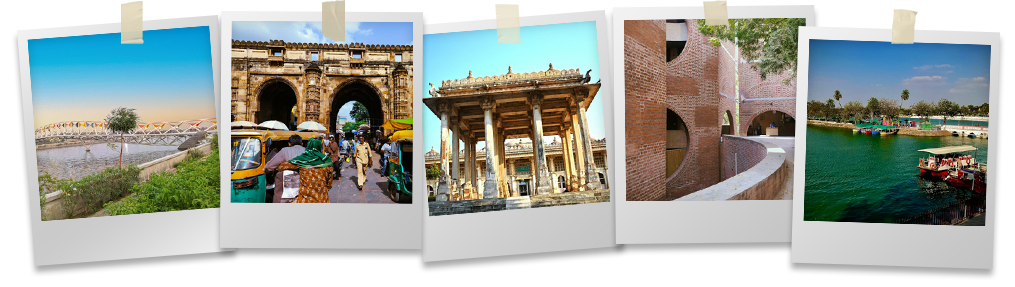
Look carefully at one of the traditional wooden houses and you begin to see how much knowledge is contained in it.
The carved façade isn’t simply decoration.
The courtyard isn’t simply beautiful.
The narrow entrance isn’t accidental.
The relationship between private and shared space tells us something about how people lived.
And then, just a few metres away, you may find something completely contemporary.
A modern shop.
A scooter.
A child coming home from school.
Someone checking their phone outside a centuries-old house.
This is not a contradiction. This is a living city.
This is also why I love bringing architecture and culture together when I travel with guests.
We can talk about Ahmedabad’s historic architecture, but we can also talk about its people, its food, its textile traditions, its entrepreneurial culture, its religious diversity and its extraordinary modern architectural legacy—from Le Corbusier and Louis Kahn to B. V. Doshi.
In one journey, Ahmedabad can take you from historic pols to modernist architecture, from traditional crafts to contemporary design.
The past is not separated from the present. It sits beside it.
And perhaps that is the real meaning of a heritage city.
Not a city preserved perfectly in time.
A city where the past continues to participate in everyday life.
This is the Ahmedabad I want our travellers to discover.
Not just Ahmedabad as a UNESCO World Heritage City.
Ahmedabad as a living city.
WalkAroundIndia — India, read differently
