

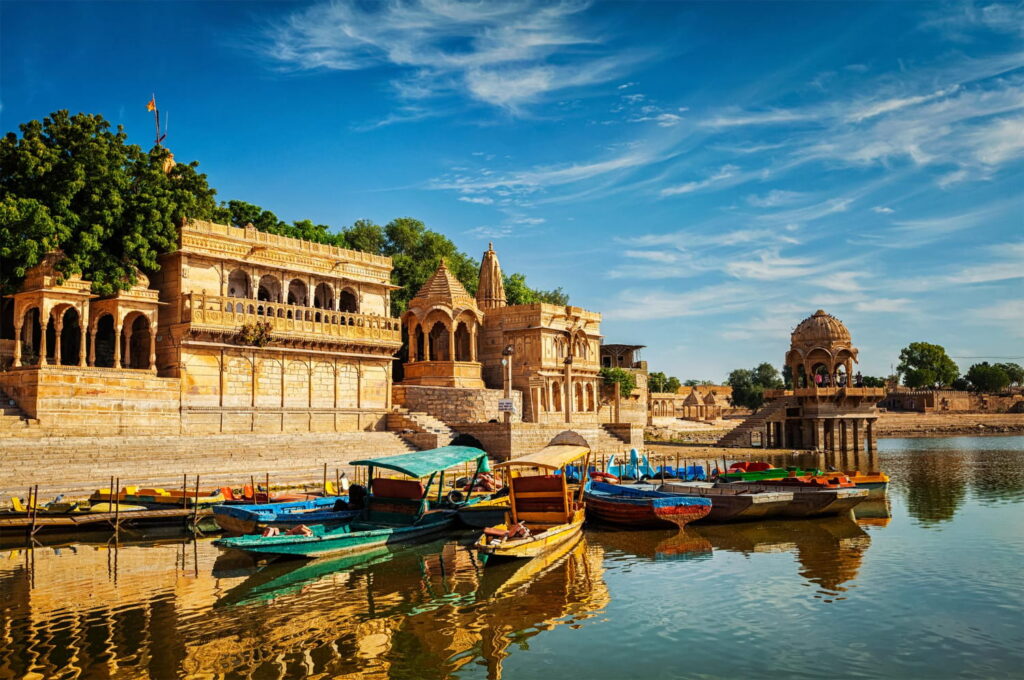
What if the architecture of Rajasthan is actually a story about survival?
When we look at Rajasthan, we often notice the beauty first.
The carved sandstone.
The ornate havelis.
The painted walls.
The jharokhas.
The forts.
The courtyards.
The beautiful colours.
But behind that beauty is another story.
**Climate.**
Water.
Heat.
Dust.
Limited resources.
And the need to make life work in a difficult environment.
That is why I often tell guests:
**Don’t just look at Rajasthan’s architecture. Ask what problem it was solving.**
Architecture begins with climate
Much of Rajasthan is characterised by hot, dry conditions and limited water availability.
Traditional architecture responded directly to this environment.
Thick walls.
Small or carefully positioned openings.
Shaded streets.
Courtyards.
Jharokhas.
Roofs and terraces.
Water storage.
Stepwells.
Johads.
These were not simply decorative choices.
They were part of a practical response to the environment.
The Rajasthan Foundation identifies jharokhas, stepwells and johads among characteristic elements of the state’s architectural heritage, while noting their practical and cultural roles.
Look at the courtyard
One of the most beautiful things about traditional Indian architecture is the courtyard.
At first glance, it may seem like an aesthetic decision.
But it can also be understood as a response to climate and social life.
A courtyard brings light and air into the building while providing a protected internal space.
It creates a transition between public and private life.
It gives families a place to gather.
It allows different parts of a house to communicate.
And it creates its own microclimate.
Suddenly, the courtyard isn’t just beautiful.
**It is intelligent.**
Then look at the jharokha
The jharokha is another wonderful example.
These projecting enclosed or semi-enclosed windows are one of the recognisable features of Rajasthan’s architectural vocabulary.
They create shade.
They allow people to look outward.
They provide privacy.
And they add depth to the façade.
But what I love most is the way they demonstrate something fundamental about architecture:
**A building can solve a practical problem and become beautiful at the same time.**
That is something modern architecture often tries to achieve deliberately.
Traditional architecture often achieved it because survival demanded it.

Water changes everything
Perhaps nowhere is the relationship between scarcity and architecture more visible than in water systems.
Stepwells are among the most remarkable examples.
Instead of treating water as something that simply arrives through a modern pipe, traditional settlements had to think carefully about collection, storage and access.
The architecture of water became part of the architecture of the city.
In Rajasthan, stepwells, tanks and rainwater systems were essential components of settlement planning. UNESCO’s documentation of Shekhawati also highlights baoris, tanks and managed catchments as integral to settlement and resource management in the arid environment.
This is why I find traditional architecture so valuable for travellers today.
It makes us ask a very contemporary question:
**What can we learn from buildings designed for scarcity?**
Jaipur offers another perspective
Jaipur is particularly fascinating because it was not an organically evolved medieval city.
It was deliberately planned in the 18th century.
UNESCO describes its grid plan, broad streets, markets, public squares, neighbourhood organisation and adaptation to its geographical setting.
It was designed as a commercial city.
That means architecture, urban planning, trade and social organisation were considered together.
The city wasn’t simply beautiful.
It was intended to **work**.
And that is what I want travellers to notice
When I take guests through Rajasthan, I don’t want to say:
“Here is a beautiful haveli.”
I want to ask:
Why does it have a courtyard?
Why are the windows shaped this way?
Why are the streets narrow?
Where did the water come from?
How did people manage the heat?
Why is the façade so richly decorated?
Who lived here?
What did they do?
What materials were available?
And what does this building tell us about the society that created it?
Because architecture becomes much more interesting when you understand the constraints behind it.
**Scarcity produces creativity.**
And Rajasthan is full of examples.
The most beautiful details are sometimes the result of very practical problems.
How do we stay cool?
How do we store water?
How do we create privacy?
How do we use local materials?
How do we live together?
That is why I love architectural travel.
It allows us to read a building almost like a document.
The walls tell us about climate.
The courtyard tells us about family.
The water system tells us about scarcity.
The materials tell us about resources.
The ornament tells us about identity.
And the whole building tells us something about the people who lived there.
**Rajasthan’s architecture is beautiful.**
But once you understand why it looks the way it does, it becomes something much more powerful:
**a record of human adaptation.**
