
Why Are Jodhpur’s Houses Blue? And is there really one answer?
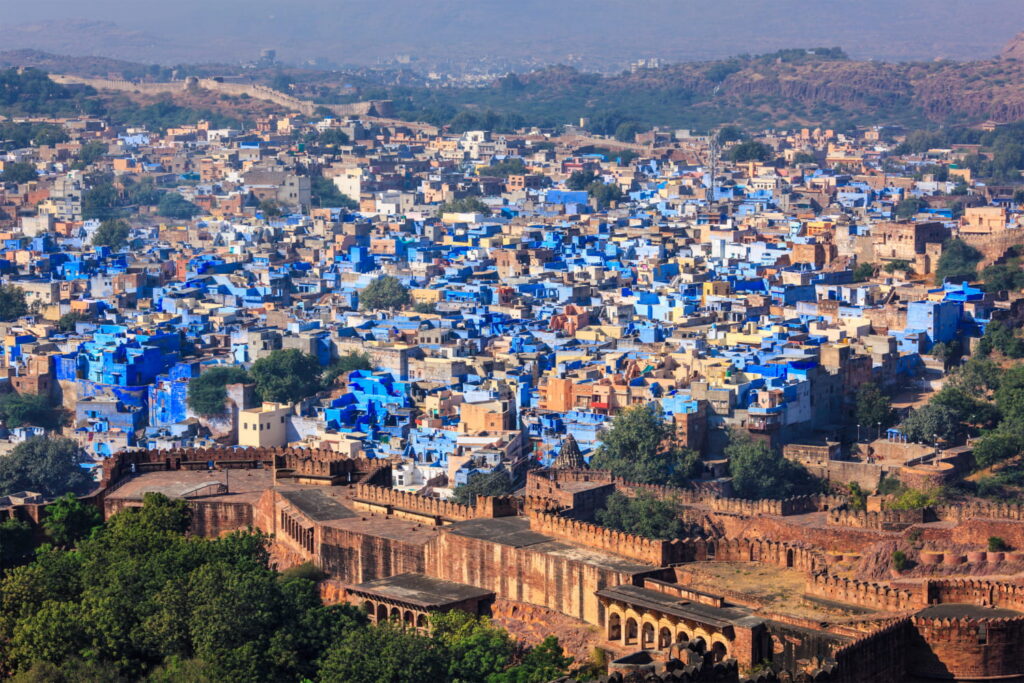
The first time you look down at Jodhpur from Mehrangarh Fort, the city seems almost unreal. Below you, the old city spreads out in shades of blue—some houses bright and intense, others faded by the sun, some almost grey, some newly painted, and some no longer blue at all. It is one of those views that makes you immediately reach for your camera.
But when I am travelling with guests, I usually don’t want the first question to be:
“Where is the best viewpoint?”
I want it to be: “Why is the city blue?” And here is the interesting part.
There isn’t one completely proven answer.
You will hear several explanations when you spend time in Jodhpur. The most commonly repeated story connects the blue houses with the Brahmin community, whose homes were traditionally painted blue as a form of social and religious identification. The practice gradually spread beyond those households, and blue became part of the visual identity of the old city. Rajasthan’s own tourism platform also records this traditional explanation.
Then there are the practical explanations.
Traditional lime-based coatings and the use of copper sulphate are often associated with the blue colour and with protection against insects and termites. Another commonly repeated explanation is that lighter, blue-tinted surfaces helped reduce the impact of the intense desert sun.
But I think the most interesting answer is actually:
Perhaps all of these stories have played a part.
Cities rarely develop their character because of one decision.
They evolve.
- A colour begins with one community.
- A material becomes practical.
- A tradition becomes fashionable.
- A neighbourhood adopts it.
- Generations repaint their homes.
- And eventually the colour becomes part of the identity of an entire city.
That is what fascinates me about Jodhpur.
The blue isn’t just a colour. It is a clue.
Look beyond the photograph
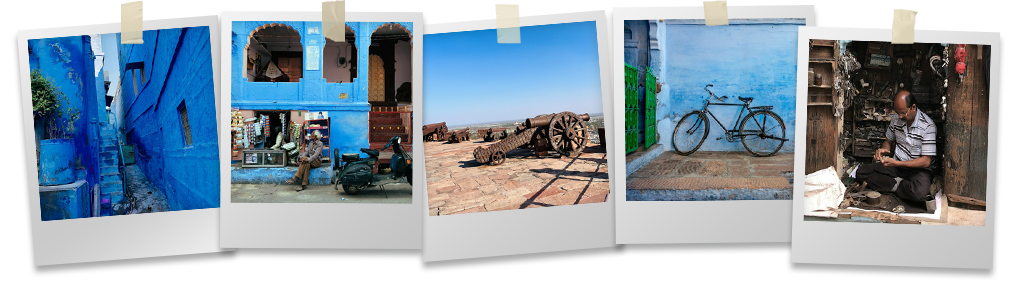
When we walk through the older neighbourhoods below Mehrangarh, I don’t want our guests to spend the entire time looking upwards and searching for the perfect blue wall.
I want them to notice what is happening around those walls.
The old houses.
The wooden doors.
The stone details.
Tiny shrines.
Courtyards.
Women sitting outside their homes.
Children returning from school.
A shopkeeper opening his shutters.
A craftsman working quietly inside a small workshop.
A rooftop where clothes are drying.
A cow blocking the lane.
A motorcycle somehow finding its way through a street that appears too narrow for it.
This is the part of Jodhpur that a photograph from the fort cannot show you.
The Blue City is not a collection of blue buildings. It is a living neighbourhood. And that distinction matters. When we design a WalkAroundIndia journey, I don’t want to take you somewhere simply because it photographs beautifully.
I want to understand what we are looking at.
Why was this house designed this way?
Why are the streets so narrow?
How does the climate influence the architecture?
Why are courtyards important?
How did the fort shape the city around it?
And how does a historic neighbourhood continue to function today?
These questions make the journey much more rewarding.
So yes, I will take you to see Jodhpur from above. But then I will take you down into the city. Because the view tells you that Jodhpur is blue.
Walking through its neighbourhoods begins to tell you why Jodhpur is Jodhpur.
This is how we travel at WalkAroundIndia.
We don’t just collect photographs.
We collect stories.
